|
Cholera in Haiti: MSF calling on all actors to step up response
November 19, 2010 |
News
HaitiAction.net |
||||
 |
 |
 |
 |
 |
 |
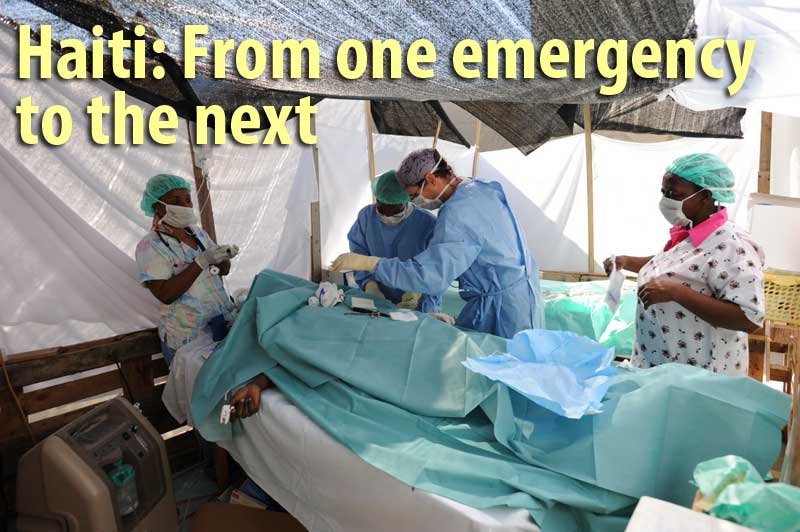 |
| January 15, 2010 - Medical care under tents continues in front of what was La Trinité trauma hospital and rehabilitation center Pacot. More than a thousands patients have received primary medical care here. The team was able to gather supplies and have set up a tented clinic using the grounds of the pharmacy. All photos ©2010 MSF/Julie Remy |
Cholera in Haiti: MSF calling on all actors to step up response
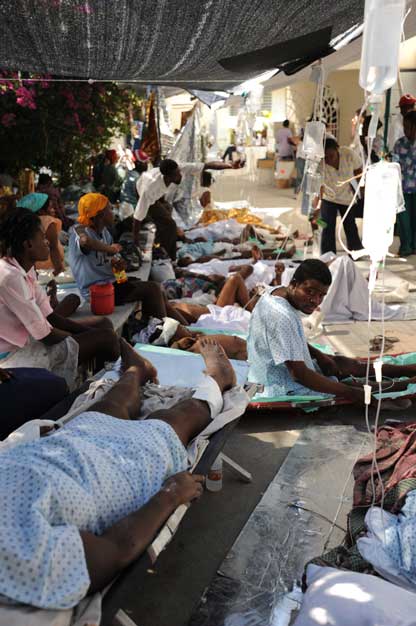 |
| Three days after the Earthquake, the plan was to keep the first tented sites for basic first aid and care and use the a new site for the many patients who need surgery. |
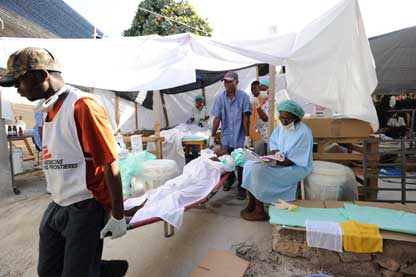 |
| Today MSF has over 1,450 Haitian employees in addition to 350 MSF staff |
While Cholera Spreads, Slow Deployment of Relief is Major Concern
Update from Doctors Without Borders
Port au Prince, Haiti - MSF — Critical shortfalls in the deployment of well-established measures to contain cholera epidemics are undermining efforts to stem the ongoing cholera outbreak in Haiti, said the international medical humanitarian organization Doctors Without Borders/Médecins Sans Frontières (MSF) today.
Despite the huge presence of international organizations in Haiti, the cholera response has to date been inadequate in meeting the needs of the population. According to national authorities, the epidemic has already caused more than 1,100 deaths and sickened at least 20,000 people nationwide.
"MSF is calling on all groups and agencies present in Haiti to step up the size and speed of their efforts to ensure an effective response to the needs of people at risk of cholera infection," said Stefano Zannini, MSF head of mission in Haiti. "More actors are needed to treat the sick and implement preventative actions, especially as cases increase dramatically across the country. There is no time left for meetings and debate – the time for action is now."
The following actions must be prioritized:
- Reassuring a population frightened by a disease that is completely unknown in the country, including by publicly communicating the low risk and positive benefits of having properly-run cholera treatment centers in close proximity to communities;
- Providing safe, chlorinated water to affected and at-risk communities nationwide, in addition to blanket distributions of soap;
- Building latrines and safely removing waste on a regular basis;
- Ensuring waste management and removal at medical facilities, in order to prevent contamination;
- Establishing waste disposal sites close to urban areas in appropriate and controlled environments;
- Establishing adequate oral rehydration points in areas where cholera cases are appearing;
- Maintaining a safe and efficient network for referral of severe cases to cholera treatment centers;
- Ensuring safe removal and burial of dead bodies.
Since the beginning of the epidemic, MSF has set up more than twenty cholera treatment facilities throughout the capital, Port-au-Prince, in the Artibonite region, and in the north of Haiti. MSF teams working around the clock have treated more than 16,500 people from October 22 to November 14. Over 240 tons of medical and logistical supplies have been brought into the country and MSF has more than 1,000 Haitian staff dedicated to cholera treatment, working alongside 150 international staff.
"Cholera is an easily preventable disease," said Caroline Seguin, MSF emergency medical coordinator. "It may be new to Haiti, but the ways to prevent and treat it are long established. Without an immediate scale up of necessary measures by international agencies and the government of Haiti, we alone cannot contain this outbreak."
In Port-au-Prince, the number of people seeking treatment at numerous MSF-run and MSF-supported medical structures jumped from 350 for the week ending November 7, to 2,250 cases for the week ending November 14. In the north of the country, MSF medical structures logged 280 cases during the week ending November 7, but that number jumped to 1,200 cases for the week ending November 14.
MSF has more than 3,000 Haitian and international medical and non-medical staff providing assistance to the population through its other ongoing programs. It runs seven free-of-charge, secondary-level care hospitals, and supports two Ministry of Health structures in Port-au-Prince, accounting for nearly 1,000 hospital beds in the capital city. Outside the capital, MSF supports a Ministry of Health hospital in the city of Jacmel which has capacity for nearly 80 beds. In Leogane, MSF has run a private emergency hospital since January , replacing it with a 120-bed container hospital in September.
Sandra Murillo
Press Officer
Doctors Without Borders/Médecins Sans Frontières (MSF)
333 Seventh Avenue, 2nd Floor
New York, NY 10001
Tel: +1 212.763.5765
Cell: +1 646.207.0405
Fax: +1 212.679.7016
www.doctorswithoutborders.org
©2010 Médecins Sans Frontières
For more information about this website HaitiAction.net - Contact us: info@haitiaction.org
Contact us: info@haitiaction.org
see also on HaitiAction.net
Haiti: Céant campaign hits the road, calling for the return of Aristide
Nov 16
Thousands demonstrate for Aristide and Jean-Henry Céant in Haiti's popular neighborhoods Nov 14
BAI protests Haiti Recovery Commission's contempt for Earthquake victims Oct 13
Haiti: US Congress members warn Clinton to include Lavalas in elections Sep 30
Haiti's Earthquake Victims: "We Have Been Forgotten" Sep 24
Rev. Jeremiah Wright: "Let's tell the truth about Haiti" Sep 21